
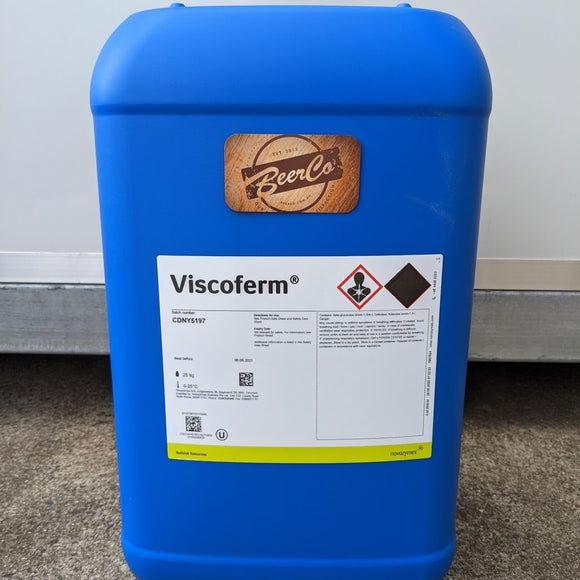

novozymes Viscoferm® is a balanced blend of xylanase, beta-glucanase and cellulase. It reduces mash viscosity in all stages of your process to deliver a range of benefits.
Viscoferm® is suitable for use on all types of small grains.
In this product the key enzyme activity is provided by endo-beta-glucanase that hydrolyzes (1,3)- or (1,4)-linkages in beta-D-glucans
Pack Size:
- 25 Kg Canister
- 1 Kg Bottle Benzyme VF - Viscosity Fermentation Enzyme Blend
- 5 Kg Bottle Benzyme VF - Viscosity Fermentation Enzyme Blend (SAVE 20% OFF 1Kg Price)
Key Benefits:
Increase output and save costs with High Gravity Fermentation.
Viscoferm provides viscosity reduction plus higher alcohol output and cost savings from:
- Rye, wheat, barley, triticale, and oats
- Fresh cassava/manioc/tapioca
- Stale and difficult-to-process corn, rice, and other raw materials
Increased output/capacity by High Gravity Fermentation (HGF)
- HGF with DS levels up to 30–35%
- Thinner mash at higher solids (less water)
Reduced costs for energy, water, and operation
- Lower energy consumption (steam, electricity, oil, gas) as less water needs to be heated, cooled, and evaporated
- More flexible backset management
- Reduced fouling, cleaning, and wear of equipment
Increased efficiency
- Better mash flow and heat exchange operations
- Improved centrifuge and evaporator efficiency
Flexibility in raw material usage
- Cereal and raw material composition can be changed and optimized according to price/availability
High dry solids (DS)
This product delivers lower mash viscosity. That means you can process higher dry solids levels, boosting your output. You can also improve heat transfer efficiency in your heat exchangers. Lower mash viscosity also leads to reduced fouling, cleaning and wear of equipment, improved mash flow and higher centrifuge and evaporator efficiency. The result is a lower energy and water spend and more cost-effective operations.
Thermostability
This product is heat stable even at the high temperatures found in the distilling process. That gives you more flexibility in your operating conditions.
Raw material flexibility
This product allows you to adjust your cereal and raw material composition for price and availability. It also allows you to include higher ratios of stale and difficult-to-process raw materials.
PRODUCT CHARACTERISTICS/PROPERTIES
Component name: Beta-glucanase (endo-1,3(4)-)
Activity: 222 FBG/g
Other Activities: Cellulase, Xylanase (endo-1,4-)
Color: Light brown
Physical form: Liquid
Approximate density (g/ml): 1.18
Color can vary from batch to batch. Color intensity is not an indication of enzyme activity.
How a blend of non-starch-degrading enzymes can reduce viscosity across the distilling process:
“Small grain” cereals including rye, barley, wheat and triticale contain non-starch polysaccharides (NSPs). These bind water, leading to high mash viscosities. High viscosity results in processing challenges. A balanced blend of non-starch-degrading enzymes breaks down the NSPs. That reduces viscosity and improves the entire distilling process.
In cereals, non-starch polysaccharides (NSPs) are the structural components of cell walls. NSPs include arabinoxylans, beta-glucans and cellulases. NSPs have a high water-binding capacity, leading to high viscosity. High viscosity has a range of negative effects across the distilling process. A highly viscous mash reduces transfer efficiency in the heat exchangers. It also means the distillery must run at a low Dry Solids (DS) level. That leads to higher energy use in steam heating the mash, vacuum cooling the cooked starch raw material and wort cooling. High viscosity reduces the efficiency of jet cooking and heat transfer in the fermenter. It also slows down the release of dissolved carbon dioxide in the fermenter.
A balanced blend of non-starch-degrading enzymes targets key water-binding NSPs. Arabinoxylans can be water unextractable (WU-AX) or water-extractable (WE-AX). The water-unextractable fraction can hold up to 10 times its weight in water. Arabinoxylans consist of α-L-arabinofuranose residues linked to a backbone chain of D-xylose residues. Xylanases break down the linear arabinoxylan backbone. That decreases the amount of water-insoluble arabinoxylans.
Beta-glucanases break down mixed-linked 1,3-1,4 β-glucans, reducing their water-binding capacity. Cellulose is a long linear polymer made of glucose. Cellulases hydrolyze the 1,4-beta-D-glycosidic linkages in cellulose. That breaks down the cellulose polymer into shorter poly- or oligosaccharides or monosaccharides. The hydrolysis reduces the water-binding capacity of cellulose.
Working together in a balanced blend, these non-starch-degrading enzymes significantly reduce mash viscosity. The result is a more energy-efficient, smoother distilling process.
Usage
Viscoferm® can be added either at mashing prior to liquefaction at 50°C or after liquefaction at 60-65°C during saccharification.

Storage:
Ideal storage conditions are 0-10°C (32-50°F) in sealed packaging in a dry environment protected from the sun. The products have been manufactured for optimum stability. However, enzymes gradually lose activity over time. Extended storage and/or adverse conditions such as higher temperatures or increased humidity may lead to a higher dosage requirement.
Safety and handling
Safety Notice: Enzymes are naturally derived proteins. While liquid enzyme preparations are dust-free, improper handling that creates mists, sprays, or dried residue dust can lead to respiratory sensitization or allergic reactions in sensitive individuals.
General Handling Precautions
Prevent Aerosol & Mist Formation: Avoid splashing, high-pressure washing, or fine atomization during mixing and liquid transfer. Inhaling airborne enzyme mists or aerosols may trigger allergic type 1 respiratory reactions.
Ensure Ventilation: Use in well-ventilated areas or under local exhaust ventilation during batching and handling.
Hygiene: Maintain good industrial hygiene practices. Wash hands with soap and water after handling, and wash contaminated clothing before re-use.
Personal Protective Equipment (PPE)
Eye Protection: Wear safety glasses with side shields or chemical splash goggles.
Skin & Hand Protection: Wear protective gloves (such as nitrile or neoprene) and long-sleeved protective workwear to minimize skin contact.
Respiratory Protection: If working in confined or poorly ventilated spaces where mists/aerosols may form, wear an approved particle respirator (e.g., P3 or HEPA filter).