
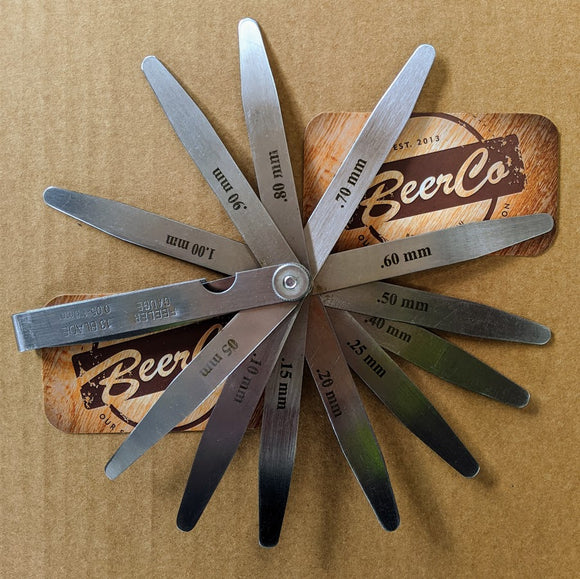
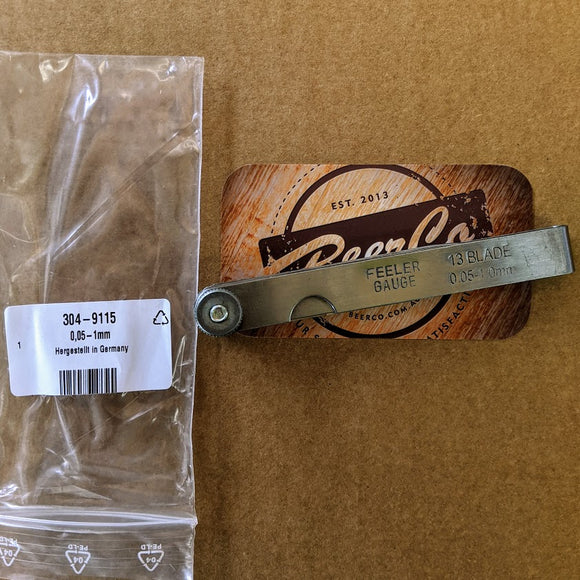
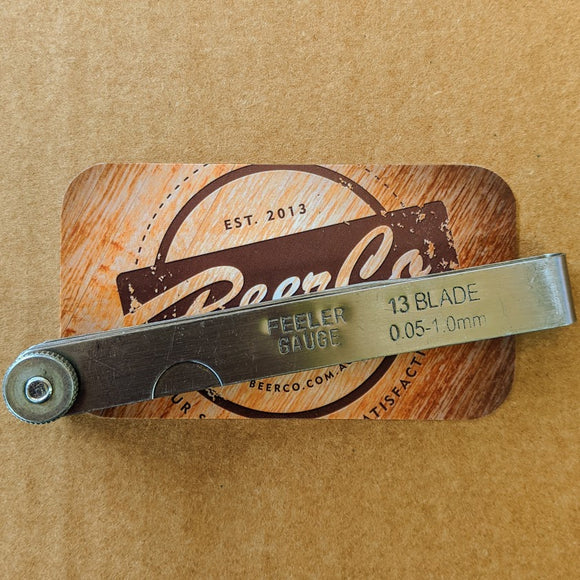
High-Precision 13-Blade Feeler Gauge (0.05mm – 1.00mm) for Grain Mills
Dial in your crush and take complete control of your mash efficiency with this German-made 13-Blade Feeler Gauge (0.05mm to 1mm). Each hardened steel blade is clearly etched with its exact metric thickness, giving brewers and distillers an accurate, repeatable way to calibrate roller spacing on a MashMaster MillMaster Mini Grain Mill or any standard two- or three-roller grain mill.
At BeerCo.com.au, we typically set our mill gap to around 1.35mm for all-grain brewing, checking and fine-tuning the rollers whenever we switch maltsters, barley varieties, or grain bills.
-
Blade Range: 13 metric blades from 0.05mm to 1.00mm
-
Country of Origin: Germany
Why Use a Feeler Gauge on Your MashMaster Mini Mill?
Relying on visual guesswork, dial markings alone, or an old credit card to set your grain mill can cost you points in mash efficiency—or leave you battling a stuck sparge on brew day. Over heavy milling sessions, vibration and load can cause roller gaps to drift slightly out of alignment.
-
True Parallel Calibration: Precision mills like the MashMaster MillMaster Mini Mill feature infinitely adjustable eccentric adjusters (0.0mm to 1.9mm) at both ends of their 130mm hardened stainless steel fluted rollers. Checking both ends and the centre of the rollers with a feeler gauge guarantees a uniform gap across the entire roller width.
-
Stack Blades for Any Gap Size: While individual blades measure from 0.05mm up to 1.00mm, you can easily stack two blades together to measure wider brewing gaps—for example, pairing the 1.00mm + 0.35mm blades to hit BeerCo's 1.35mm sweet spot.
-
Batch-to-Batch Repeatability: Barley kernel size varies between harvests, maltsters, and grain styles (such as plump pale ale malt versus smaller wheat or rye). Recording your preferred feeler gauge measurements lets you reset your mill in seconds.
What is the Ideal Crush for Malted Barley?
Milling malted barley is a balancing act between exposing the starchy inner endosperm for rapid enzymatic conversion and preserving the outer husk so your mash drains cleanly.
An ideal crush produces coarse, granular endosperm grits, mostly intact husks (cracked open rather than shredded), and minimal fine flour (ideally under 10% by weight):
-
If your mill gap is too wide: Whole or barely cracked kernels slip through untouched, locking away fermentable sugars and dropping your extract efficiency.
-
If your mill gap is too tight: Husks are pulverised into fine dust and flour, creating a doughy grain bed that restricts wort flow and causes slow runoffs or stuck mashes.
Recommended Mill Gap Settings for Brewing & Distilling
Different mashing systems and fermentation styles call for slightly different crush profiles. Use the gap settings below as your starting baseline, then inspect a handful of crushed grain to fine-tune:
| Brewing or Distilling Method | Recommended Mill Gap | Crush Profile & Why It Works |
| Traditional Mash Tun & All-in-One Systems (Grainfather, BrewZilla, HERMS/RIMS) | 1.10mm – 1.40mm (BeerCo standard: ~1.35mm) | Cracks kernels cleanly while keeping husks intact to form a natural filter bed for clear wort and smooth sparging. |
| Brew-in-a-Bag (BIAB) & No-Sparge | 0.80mm – 1.00mm | Because a mesh filter bag supports the grain bed rather than a false bottom, a tighter crush boosts extract efficiency without stuck-sparge risk. |
| Huskless & Small-Kernel Malts (Wheat, Rye, Oat Malt) | 0.70mm – 0.90mm | Narrower kernels require a tighter roller gap to ensure every grain is properly cracked. |
| Off-Grain Distilling (Lautered Single Malt Whisky Wash) | 1.00mm – 1.30mm | Preserves husk integrity so sweet wash can be cleanly separated from spent grain before fermentation and distillation, reducing boiler scorching. |
| On-Grain Distilling (Fermenting & Distilling on the Grain) | 0.70mm – 1.00mm | Maximises starch conversion and spirit yield when no lautering is required—aim for fine grits rather than pure flour so the mash remains easy to stir or pump. |
(Note: Two-roller fluted mills like the MashMaster Mini Mill are purpose-built for malted barley and malted grains. If you are milling hard, unmalted corn or raw cereal adjuncts for distilling, use a dedicated hammer mill or flour mill.)
How to Set Your Grain Mill Gap in 4 Quick Steps
-
Disconnect Power: Always unplug your motorised mill or remove your drill driver before placing tools near the rollers.
-
Loosen the Rollers: Release the locking pins or adjustment knobs on both ends of the mill.
-
Measure Both Ends & Centre: Select the single blade (or stacked blade combination) matching your target gap. Slide it between the rollers on the left side, middle, and right side, adjusting the eccentric dials until you feel light, even drag without having to force the blade.
-
Lock & Test: Tighten the locking mechanism, re-verify the gap, and run a small handful of malt through the mill to visually confirm the kernels are cleanly cracked before milling your full grain bill.
For a closer look at dialing in your rollers, watch our YouTube guide: Brew Like a Pro! The Perfect Grain Crush.