
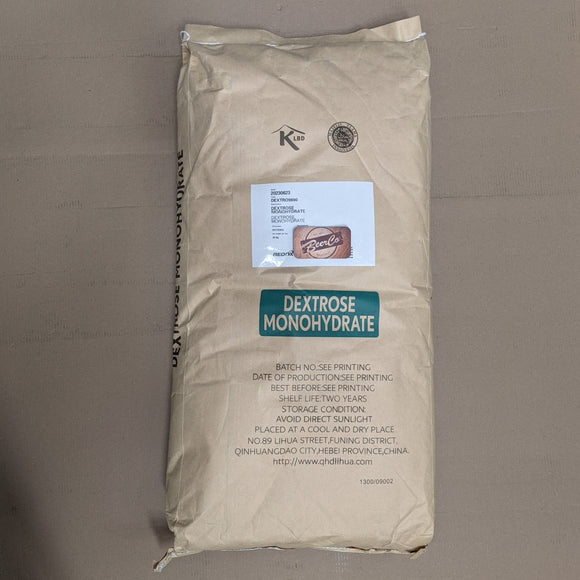
Dextrose brewing sugar, often referred to as "corn sugar" or "glucose" can be used in place of white sugar "sucrose" in either your fermentation or for priming your beer when bottling or kegging. Dextrose is faster to dissolve than white sugar and 100% fermentable. Dextrose often referred to as Corn Sugar: Probably the most common of the sugars discussed in brewing, Dextrose or corn sugar is made up almost entirely of glucose/dextrose. It will ferment completely, contributing more alcohol content than a similar amount of malt extract, and will lighten the body and flavor of the brew. Corn sugar will also ferment very rapidly, and will thus shorten the time your beer will need to spend fermenting. The most common use of corn sugar is as a priming sugar during the bottling process.
Form & Pack Size Available:
- 1 Kg bag
- 5 Kg bag (SAVE 20% OFF 1 Kg Price)
- 25 Kg Sack (SAVE 36% OFF 1 Kg Price)
Dextrose is another name for naturally occurring glucose. Chemical compounds can have two forms or mirror images called stereoisomers. In nature the dominant form of glucose produced is the right-handed isomer called D-glucose, with the left-handed form referred to as L-glucose. D-glucose is commonly referred to as dextrose, the shortened version of “dextrorotatory glucose.” Dextrose is a monosaccharide, a simple sugar, and is used as a building block for biological structures or can be broken down to power life-sustaining biochemical reactions. During the production of beer, mashing of grain breaks down many compounds with starch comprising a bulk of the targeted compounds. The starches are broken down by enzymes into the constituent parts, and some of these are dextrose molecules. During the kettle boil some dextrose binds with nitrogen-containing substances in a color- and flavor-forming Maillard reaction. Dextrose, along with other sugars, is consumed by yeast during fermentation and in turn yeast release alcohol, carbon dioxide, and flavor and aroma active compounds. Dextrose is the fermentation sugar first utilized by yeast at the outset of fermentation, so by the end of fermentation it is rarely present in beer above sensory threshold. Dextrose can be produced from many different starches, including corn, rice, cassava, and wheat. As dextrose is highly fermentable, it facilitates the brewing of very dry high gravity beers. Dextrose is also commonly used as priming sugar for bottle-conditioning. It is also widely used by "Kit & Kilo" brewers or extract brewers and is a commonly used Adjunct when brewing a dry West Coast Style US IPA where a high gravity beer is sought without making the beer mouthfeel too malty. What is Sugar? But before we can answer the questions about what Sugar to use in your brew, we need to lay some groundwork and describe the different building blocks of Sugar. Once you understand what everything is made of, it becomes a lot easier to understand the answers. All sugars are carbohydrates, molecules that contain both carbon (carbo-) and hydrogen (-hydrate) atoms. Carbohydrates have the general formula of CnH2nOn, meaning they have one carbon (C) and one oxygen (O) to every two hydrogens (H2). In sugars, the “n” usually equals 5 or 6. For example, glucose has the formula C6H12O6, meaning it is constructed of six carbon atoms, twelve hydrogen atoms and six oxygen atoms. Incidentally, fructose also has the formula C6H12O6, but the atoms are arranged differently in the molecule. Brewing beer is all about working with sugars — glucose (dextrose), fructose, sucrose, maltose, verbose and all the rest. The most common type of sugar is called glucose (aka. dextrose, blood sugar, corn sugar). Glucose is a monosaccharide, hexose-type sugar, meaning that it is a single molecule consisting of six carbon atoms. Other hexoses relevant to brewing are fructose and galactose. Elementally, these monosaccharides are all the same, but they are isomers of each other i.e., their chemical structure and arrangement gives them different properties. For instance, an isomer of glucose called fructose (also known as fruit sugar), tastes sweeter than glucose. Lots of different sugars can be used in brewing, and when we know that yeast want to eat and when, we can make better choices for their use. Why would we want to use anything other than the sugars that come naturally form the barley? Well there are a few reasons that may apply in some circumstances: a.) To raise the alcohol level without increasing the body of the beer. b.) To lighten the body of the beer while maintaining the alcohol level. c.) To add some interesting flavors. d.) To prime the beer for carbonation.
Alternative Brewing Sugars
The bulk of the fermentable sugars in beer come from malts and malt extracts - that's what makes it beer. However, there are a number of other sugars that, when used in smaller quantities, can impart their own distinct characteristics to your brew. Here, we'll discuss the major alternative sugars, the effects they may have on the finished product, and the best ways to use them. Sugar is a simple carbohydrate. That is, it is a single molecule made up of some configuration of carbon, hydrogen and oxygen. Starches are complex carbohydrates, which means that they are made up of chains of sugar molecules bonded together. The breaking of these chains by various processes or enzymes converts the starches into their component sugars. The amylase enzyme in saliva is a good example of this. A common grade school science experiment is to take a saltine, place it in your mouth and chew it slowly 100 times. By the time you're done, you'll notice that the normal starchy, floury cracker taste has been replaced in part by a sweeter flavor. This is your saliva breaking down the starch chain into sugars. The mashing process affects malted barley in the same way, which is how malt extracts are made. These extracts are composed primarily of a sugar called maltose. Chemically, maltose is one of five major types of sugars. Sucrose is the name for common table sugar, which is usually derived from beets or sugar cane. Fructose is the sweetest tasting of the sugars, and occurs naturally in fruit, and to a lesser degree in malt. Glucose and dextrose are molecularly the same, and most commonly sold as syrup and dry crystals, respectively. Finally, lactose is a sugar which is naturally present in milk. Fructose, dextrose and sucrose are all very easily and rapidly fermentable by beer yeast. Maltose is obviously fermentable as well, but the process takes somewhat longer, and lactose is not fermentable at all by normal beer yeasts alone. Certain wild yeasts can ferment lactose, and various enzymes can be introduced which will help beer yeast ferment it as well. While there are a wide variety of sugars available to the homebrewer, it should be kept in mind that excessive use of any non-malt sugar will detract from its characteristic flavor and make your beer considerably less beer-like. In general, these sugars should not make up any more than 25% or so of the total sugar content of your wort. Some sugars also contribute strong flavors to your beer, or have other special considerations.
Certificate of Analysis:
Sauces of Brewspiration and Further Reading for You:
- John Palmer Brewing Sugars & How to Use Them BYO.com
- Dextrose | Craft Beer & Brewing Magazine
- Kunze, Wolfgang. Technology Brewing and Malting, 2nd ed. Berlin: VLB Berlin, 1999
- Alternative Brewing Sugars | Aussie Homebrewer
Product title
$19.99 | $24.99
Product title
$19.99 | $24.99
Product title
$19.99 | $24.99
Product title
$19.99 | $24.99
Great Product, easy to mix, great value for money
Hi Darren, thank you for your fantastic review! We're thrilled to hear you're satisfied with the product and value. Cheers from BeerCo.com.au!
Very happy with the service
Hi Tim, we're so glad to hear you're happy with our service! Thanks for your kind words and for choosing BeerCo.com.au.
Did the job
Hi Brendan, we're glad to hear it did the job! Thanks for your support. cheers
Did the job 👍
Hi Brendan, thanks for your great review! We're happy to hear the product did the job. Cheers from BeerCo.com.au!
Best product
Tanks Stephen,
Glad you enjoy using it! cheers #distilsafely always
Every brew gets dextrose
Tanks for your review after your brew happy Andre
Good quality produce
Thanks Van,
Appreciate your valued custom and feedback.
The product is fine and it came really quickly.
Tanks Conrad,
We are pleased to hear our service was speedy for you! cheers
Great Staff, Great Service along with Great Prices. Only place I shop for supplies.
Tanks Undergroundmusic,
Always our pleasure to supply and be of service to you! Have another great brewing week/end
Exactly as described
Tanks Dale,
Hop you are well and having a great making week!
Great service Great product
Tanks Andrew,
We appreciate you taking the time to review. cheers
Great price and good product
love the products, best of all the delivery is exceptional
Quick delivery of a good product at a great price.
Wow, talk about fast delivery! Ordered and delivered in two days. Will definitely be using you guys again.
Would highly recommend!
Thanks, you guys rock.
It is indeed sugar!
Had no issues, sugar was great. Shipping was super quick.